

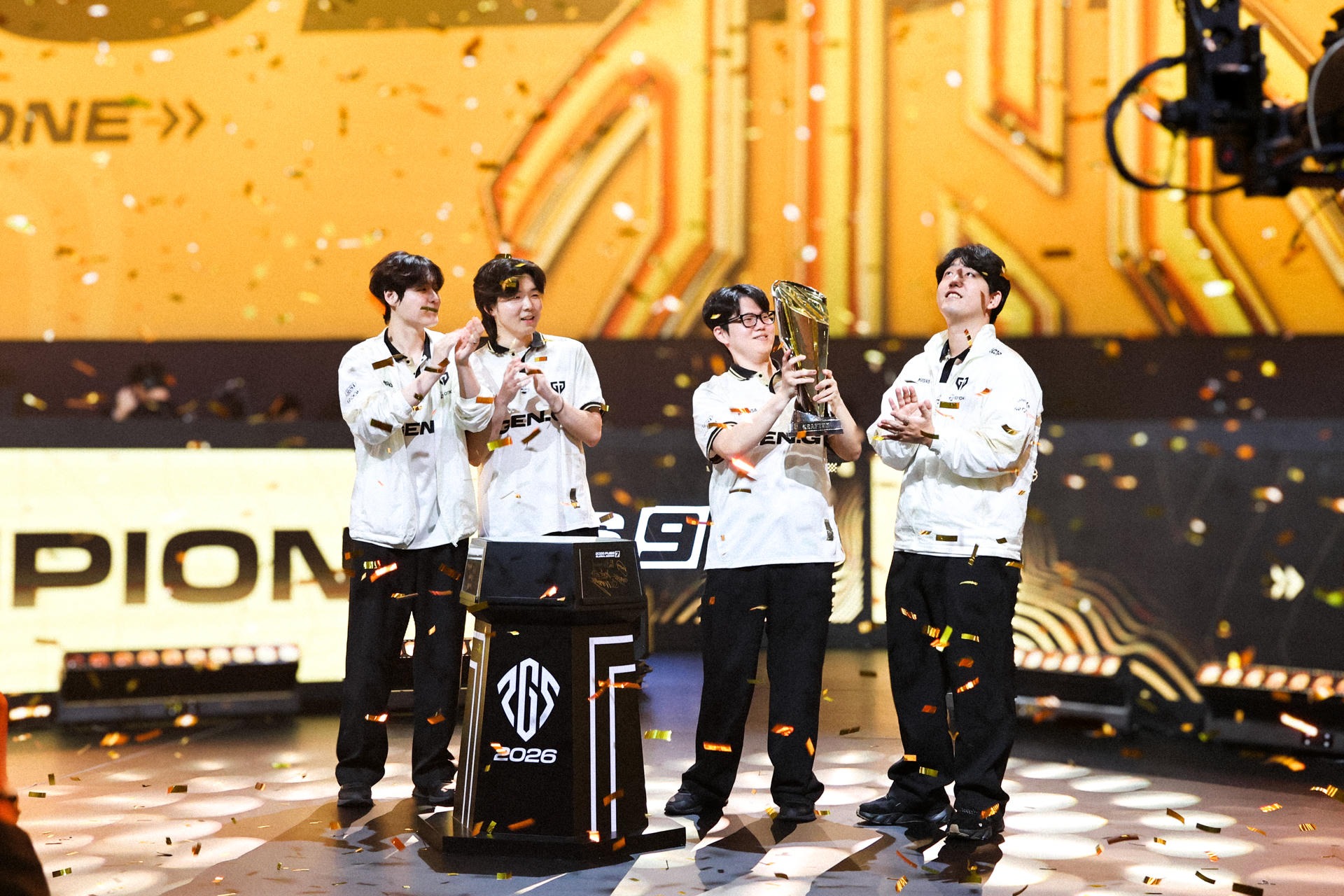
In the wake of Gen.G’s dramatic PGS 9 tournament win, we enlisted the help of PUBG expert reporter Jisooboy to analyse what precisely led to their tournament win! Here’s what they had to say:
When people think of the greatest organizations in PUBG Esports, a few teams naturally come to mind. Among them is Gen.G Esports, the 2019 PGC champion and a storied organization that has represented PUBG Esports for years. Yet after winning PGC 2019, Gen.G struggled to produce meaningful results. Following a third-place finish at PGI.S 2021, the team failed to win a single title across the PCS ASIA series or any subsequent PGC. Despite multiple rebuilds year after year, its only notable result was a runner-up finish at EWC 2025. Gen.G clearly needed a change.
Perhaps that is why Gen.G entered this year with a different level of ambition. The team signed seoul Cho Gi-yeol and Salute Woo Je-hyeon, both members of the PGC 2023 championship roster, as well as diyy Daniel Noh Noh Eun-woo, who had delivered standout performances for Al Qadsiah. In particular, seoul and Salute had been regarded as one of Korea’s strongest duos, sending expectations among PUBG Esports fans sky-high.
But the result of that major rebuild was disastrous. Gen.G finished only fourth in the domestic PWS, while its chances of qualifying for PGC began to fade. The team missed the Finals four times—at PGS 1, 2, 5, and 7 in 2026—and across 123 PGS matches recorded just seven Chicken Dinners, 3.49 kills per match, and 789 average damage per match. The numbers did not lie. It would not have been an exaggeration to call Gen.G one of the weakest Partner Teams competing in PGS.
Sure enough, Gen.G opened the first PGS Circuit, Circuit 1, by missing the Finals three times in a row. Gen.G was not alone—many teams that had undergone major rebuilds were also struggling to find their footing—but three consecutive Finals misses in Circuit 1 was still a shocking result.
As a Global Partner Team, Gen.G had the advantage of guaranteed participation in the PGS Circuit and more opportunities to accumulate PGS Points. Even so, it was pushed aside by established Partner Teams and strong regional qualifiers, failing not only to break into the PGS top eight but even falling into the bottom tier of the standings. Considering Gen.G’s history on the international stage, it was a deeply disappointing run.
The crisis continued in PGS Circuit 2. Gen.G appeared to be turning things around with a sixth-place finish at PGS 4, only to finish 23rd at PGS 5 and miss the Finals once again. The swings could hardly have been more extreme. The team returned to the Finals at PGS 6, but finished just 13th overall. Without a dramatic turnaround in Circuit 3, direct qualification to PGC was becoming almost impossible to imagine.
In my view, there were two main reasons for Gen.G’s struggles. First, the team had not had enough time to build chemistry. Second, communication was not yet smooth. Individual skill was never the issue. Every player already had extensive international experience and an impressive career behind them.
Meanwhile, the 2026 PUBG Esports season began with PGS. Many teams had rebuilt their rosters in January 2026, and because the opening competition was an international event rather than a domestic league, the level of opposition was extremely high. In roughly two months, teams had to establish their approach to macro play, understand each new teammate’s tendencies, sharpen the precision of information sharing, and raise the level of their teamplay in fights.
For newly signed diyy in particular, the language barrier made it difficult to exchange information and coordinate opinions smoothly with his teammates. It was something that had surfaced across tournaments, scrims, personal streams, and Ranked play, and it did not look like an issue that could be solved overnight. Beyond the differences in how overseas and Korean players make comms, it is difficult to completely learn every in-game callout, terrain reference, and piece of slang in just a few months. A building called ‘Palgakjeong’ in Korea, for example, may be called ‘Wizard Tower’ overseas. Depending on the map, there can be hundreds of callouts like these.
As these issues accumulated, comms mistakes became more frequent and information took longer to relay, inevitably leading to repeated teamkills and in-game errors. While Gen.G worked through that process, rival teams steadily built their own careers and collected prize money. Gen.G could do little but watch from the sidelines.
After enduring all of those difficulties, signs of change finally began to appear for Gen.G in PGS Circuit 3. The team finished only 11th overall at PGS 8, but many of the issues that had been repeatedly pointed out were beginning to improve. The result itself was not strong, yet the quality of Gen.G’s play had changed significantly. Cleaner comms, pre-planned setups, and more precise approaches began to take shape. As the team reorganized its positions and role order, both survival time and the rate at which it secured Placement Points began to rise.
PGS 8 Finals DAY 1 MATCH 1 — Erangel
Looking at Gen.G’s Chicken Dinner in Finals DAY 1 MATCH 1 on Erangel, the team focused on keeping all four players alive by denying routes other teams could use and gathering information before winning the decisive fight. The closing sequence still showed some instability. Gen.G held the stronger position, but when information about each player’s situation was not shared quickly enough, dangerous moments like this could still occur. Even so, the match helped Gen.G sharpen its form as the tournament progressed.
PGS 8 Finals DAY 2 MATCH 2 — Erangel
The second highlight was how well the revised roles worked in tournament play. Gen.G’s typical losing pattern had often looked like this: ① Salute looks for an angle to hunt another team → ② if the opponent responds well or Gen.G cannot execute quickly as a team, Salute is neutralized → ③ BeaN and diyy try to help, only to get knocked in succession or draw a third party → ④ Seoul makes a big play at the end, but the team still goes down soon after.
Gen.G’s Typical Losing Pattern
Over time, however, the revised positioning and order changed that pattern. When Gen.G needed to look for a third-party angle or take the initiative and eliminate an opponent first, Seoul moved to the front, combining detailed reads of the situation with smooth, persistent pressure. BeaN and diyy acted as the glue in the middle, while Salute surveyed the wider battlefield from the backline and took responsibility for the final calls. The new structure began to pay off.
The role changes improved Gen.G’s overall survival time and Placement Point output. At the PGS 6 Grand Finals, Gen.G averaged only 1.4 Placement Points per match; by the PGS 9 Finals, that figure had risen to 3.9. The team’s average survival time also increased from 20 minutes 53 seconds to 22 minutes 38 seconds. Salute’s combat numbers, which had dipped somewhat after taking on the main IGL role, also began to recover. Team average damage jumped sharply from 672 to 980.
In a way, perhaps every problem Gen.G had faced ultimately came down to time. Salute, for example, moved from an attacking role into responsibility for the team’s calls, giving him far more to process and manage and preventing him from playing at his best. BeaN, serving as the glue of the team, needed above all to become a stable, mistake-free presence with the ability to survive tenaciously—and it took time to fully develop that role. Seoul was always elite statistically, but those numbers had largely been individual. There were moments when he needed to step forward before the team began to collapse. diyy, meanwhile, needed to reshape the entire style of play he had been accustomed to.
Gen.G’s strengths are now clear. The team had always built good scenarios for attacking opponents, but it lacked the finishing power and clearly defined roles needed to complete them. Now Seoul and Salute, two of the best players in the world, have fully settled into their respective roles, while BeaN’s survival instincts—honed over years in the PUBG scene—have matured into a major strength. Even diyy, who had repeatedly made costly mistakes, played the biggest role in delivering Gen.G the championship in the final match of the PGS 9 FINAL.
Salute’s Read of the Situation + Seoul’s Composed Finish
BeaN’s Brilliant Placement Defense
diyy’s Winning Play for the Championship
Of course, while this column was being written, it was announced that diyy had ended his contract and transferred to Team Liquid on August 25, 2026. Gen.G then announced another rebuild by signing taemin Kang Tae-min on August 27, 2026, one of the key players from the PGC 2019 championship roster. There is a chance that the gaps discussed above could emerge once again, but every player on Gen.G has the experience and skill to fill them, so there may be little reason for serious concern.
Closing
994 days.
That is how long Korean PUBG Esports had gone quiet on the international stage since its PGC 2023 championship. Gen.G, too, had to endure repeated failures and rebuilds while searching for a way back to the top. The players changed roles, learned to understand one another’s play, and endured countless rounds of trial and error before finally becoming one complete team. In the end, what made Gen.G a top team again was not a single signing or one special strategy. It was the time required to understand one another, the experience gained by enduring failure, and the determination of players who refused to give up until the very end.
After quietly enduring failure after failure, Gen.G finally lifted an international trophy. In doing so, one of PUBG Esports’ most storied organizations proved itself once again: a great team is not simply made—it is completed only after surviving countless failures. We remember all the losses they endured in order to become stronger. And those memories will only make Gen.G stronger still.
- Jisooboy