

With PGS 7 in the rear view mirror, we caught up with our PGS reporter Jisooboy to get their expert insights on why the tournament unfolded in the way it did!
"Life is C(Choice) between B(Birth) and D(Death)."
I brought a famous quote to kick things off. In PUBG, players land with bare hands, but the outcome is ultimately determined by the choices they make. On the perilous boundary between life and death, players have always carved out their own destiny through those crucial choices.
Numerous factors are considered when making these decisions, but the most critical of all is undoubtedly the Blue Zone. Whether you are a casual player or a pro, preferred drop zones or cities may shift depending on the flight path (plane trajectory). However, no one can predict where the Blue Zone will shrink once everyone hits the ground. Thus, navigating the Blue Zone has always been a realm of experience and intuition, never of absolute certainty.
Particularly, the classic Blue Zone settings we were all accustomed to underwent a massive overhaul with the Update 42.1 Patch on June 16, 2026. The durations of the early and final phases were shortened, the overall size of the safe zones was reduced, and the Blue Zone damage scale shifted from a distance-based system to a cumulative time-spent system. Most importantly, the land-prioritization algorithm that assisted safe zone generation was completely removed.
Due to this monumental shift, teams that traditionally relied on "circle-reading" and strategic macro-play as their primary strengths have struggled significantly. Strategic powerhouses like DN SOOPERS, Team Vitality, and Team Falcons were pushed to the brink, finding themselves relegated from the Group Stage to the Survival Stage. Although they eventually clawed their way into the Final Stage, none of them walked away with results they could truly be satisfied with.
This crisis was not unique to macro-heavy teams either. Even squads renowned for their raw skirmishing power and gunplay, such as T1 and Natus Vincere, failed to even qualify for the Final Stage. While we witnessed numerous moments where players were picked off while rotating under time pressure, the shrink in the initial Blue Zone's area also created clear pressure points where teams were forced to make high-stakes decisions much faster than before.
Specifically, as the Phase 4 Blue Zone—which heavily dictates the momentum of any match—introduced a higher degree of randomness, the historical circle-prediction data used by many teams has been completely rewritten. Let's look at a concrete example.
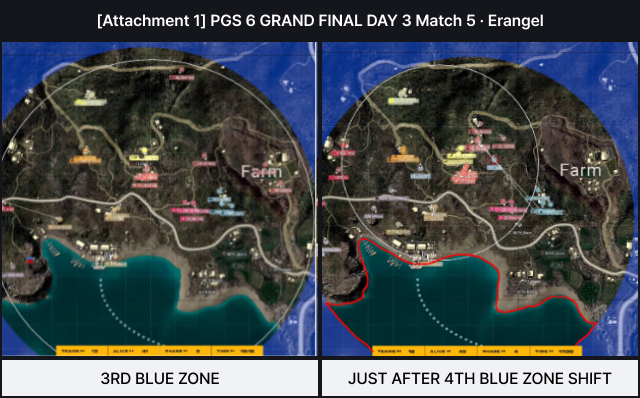


The Blue Zone behavior we previously knew is illustrated in [Attachment 1]. Especially when the circle pulled over water or rivers, it was essential for teams to analyze the ratio of land—which had a higher probability of pulling the next circle away from the water—to predict Phase 4 and preemptively seize high-tier compounds or defensive ridges. In that meta, certain spots were classified as highly reliable, go-to strongholds for mid-to-late game macro, earning them the nickname "Science" because teams could blind-drop or rotate into them without a second thought.
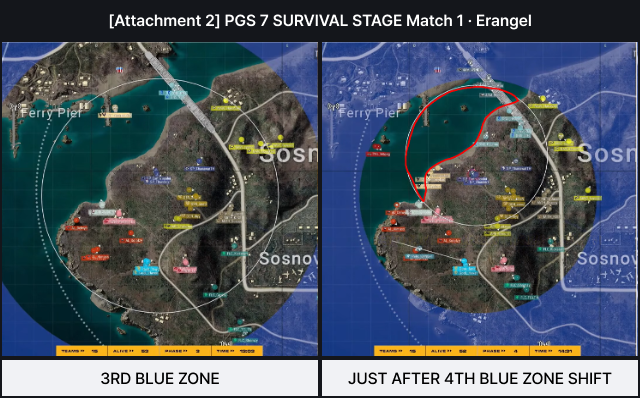
However, with this Blue Zone reform patch, it is safe to say those "scientific rules" have vanished. Formulaic circle patterns have disappeared, and highly volatile, unpredictable circles have emerged. Consequently, the strategic value of early-centering or rushing to secure a central compound has been somewhat diluted. As shown in [Attachment 2], despite the heavy presence of water, a massive portion of the sea remains engulfed inside the active safe zone.
Match Survival Statistics (At the 10-Minute Mark)
Furthermore, as the early-phase Blue Zone times were cut short and their areas reduced, players' rotation paths frequently overlapped. This has had a direct impact on the match survival rate. Below is the compiled data:
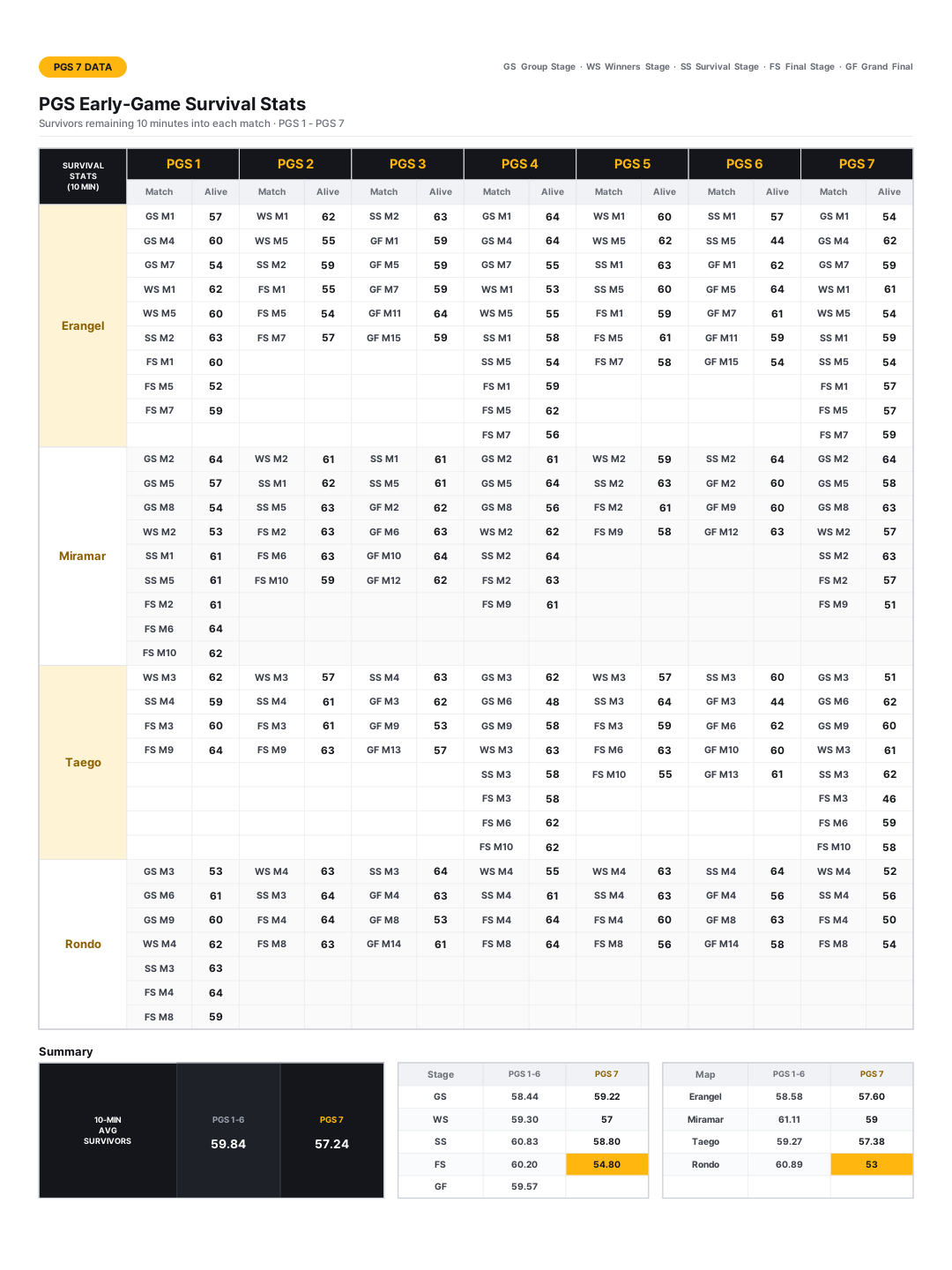

GS: Group Stage / WS: Winners Stage / SS: Survival Stage / FS: Final Stage / GF: Grand Final
To conduct this data analysis, I reviewed every single match across all previous PGS iterations, manually counting and recording the number of active players surviving at the exact 10-minute mark.
While the current sample size under the new Blue Zone settings is still somewhat limited, the rule change has clearly driven a statistically significant drop in early-game survival numbers. Overall, the survival rate has decreased. Notably, we observed a massive drop-off in survivor counts during the Final Stage and on the map Rondo. Given the high-stakes nature of the Final Stage compared to the Group, Winners, or Survival Stages, combined with Rondo's incredibly vast terrain, we saw several teams in PGS 7 opt for highly aggressive, early rotations or make high-risk, high-reward gambles.
This survival drop was not uniform across all stages and maps. By stage, the Group Stage actually saw a slight increase in survival, while the Winners and Survival Stages showed a minor drop of about 2 players. However, in the Final Stage, the survival rate plummeted by 5.4 players. This data suggests that the new Blue Zone doesn't simply force early engagements across the board; rather, its impact is amplified dramatically on specific maps and during higher-stakes stages.
Of course, a holistic analysis must account for several other variables. We must examine qualitative factors that cannot be captured by raw data alone—such as the specific map pool, participating team rosters, team-specific tactical playstyles and tendencies, hot-drop/landmark conflicts, starting flight paths, Phase 1 circle shapes, and stage-specific lobby dynamics. While PGS 7 is the only tournament played under the updated Blue Zone rules so far, we will undoubtedly secure more reliable data and stronger statistical significance once PGS 8 and PGS 9 are concluded.
PUBG Esports athletes are constantly fighting for survival, chasing the clock under extreme pressure. At times, they are forced into unavoidable compromises, and they often fall victim to incredibly unforgiving circle shifts. Nonetheless, the beauty of PUBG Esports is that these players will adapt, and today's defeated squad can easily become tomorrow's champion. Survival or elimination—on that knife-edge boundary, which team do you think will make the ultimate winning choice?
- Jisooboy