

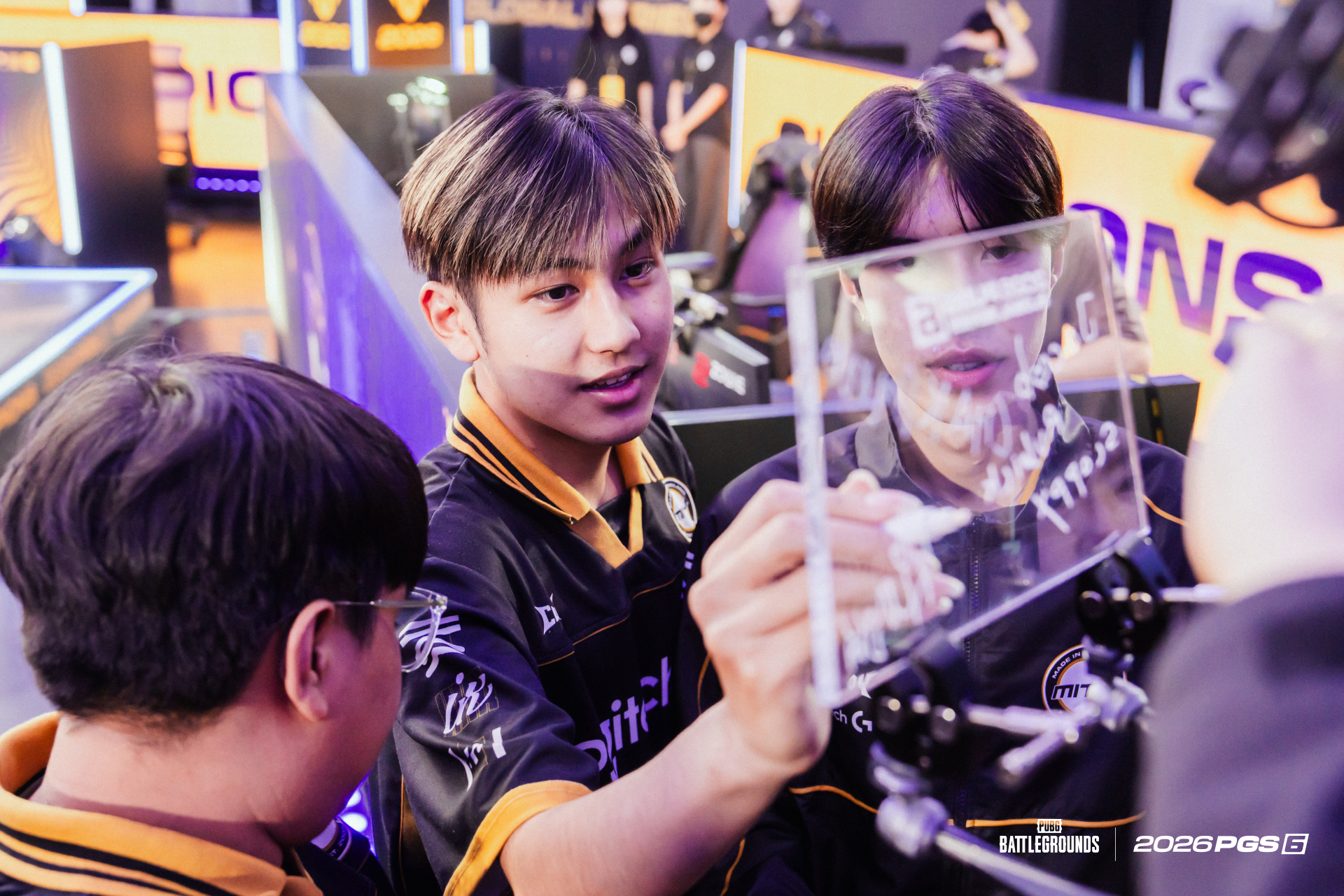
I admit defeat. In my last column, I chose Natus Vincere, Virtus.pro, and 17Gaming as the absolute strongest title contenders for PGS 6. It wasn't that I ruled out the possibility of other teams winning, but leaving them out of the column because I thought others had better odds was a critical misjudgment. They grew much faster than expected, became terrifyingly solid, and overwhelmed the other teams throughout the tournament. So, who won? In this column, I'd like to tell the story of the PGS 6 champions and the legacy team of Thailand, Made in Thailand (MiTH).
MiTH was founded in 2017. There was a time when they swept every regional tournament. Popular Thai players like MinORu and Ezqelusia were among the founding members. But holding onto both popularity and results was fleeting; pushed aside by regional powerhouses in Thailand, MiTH's performance and reputation continued to decline day by day. They brought in the highly skilled DUCKMANZ midway, which seemed to spark a brief resurgence, but that too was only momentary.
As the years passed, dominance in the APAC region remained elusive for MiTH. In 2024, CERBERUS ESPORTS claimed the PGS championship spearheaded by Himass, and in December of the same year, The Expendables, led by Delwyn, hoisted the PGC trophy. At the PGC in December '25, the Thai team FULL SENSE took the championship, but MiTH finished in 23rd place.
Amidst this trend, eArena (EA) and Forest Natural Gaming (FNG) began to stand out. These two teams were emerging as the new hope in place of MiTH. Although they didn't reach a global championship win, they recorded impressive results and were recognized for their potential. In particular, EA's Jacob was considered the rising superstar of Thailand, and FNG's starters KISS, Scappy, and Baren were highly praised players, known for their exceptional teamwork, combat skills, and individual prowess.
Aligning with the '25 PGC period, MiTH recruited the aforementioned three FNG starters. Early the following year in '26, they brought in EA's core member and ace Jacob as their IGL, further bolstering their roster and raising expectations. Considering these are among the youngest players in the Thai scene, yet possess significant experience in major international tournaments, building synergy quickly around players who had already played together for a long time was undeniably a massive upgrade in fighting power.
In the past, the trend in PUBG Esports favored teams with distinct role-playing capabilities. An IGL who couldn't shoot well was still highly regarded if they could find the right path and guide the team's macro direction. Fraggers just needed to shoot well, while support players meticulously managed the variables for the team.
But times have changed. Now, everyone must be able to make calls depending on the situation, collectively discuss the team's direction, and frag heavily while carefully checking all variables—this is the only way to win in international tournaments.
If a team doesn't fit that mold, they need an extraordinary edge that cannot be compared to any other team. Natus Vincere (NAVI), who swept the championship by putting every team in the dirt with overwhelming firepower, is a prime example of this.
MiTH is a bit different. They play calmly, observing the situations of other teams, but they have their own definitive plan. They have more than enough mechanical skill to execute that plan, and their resilience to recover from taking damage is ridiculously good. On top of that, they possess an unmatched supreme ace. While many teams took turns winning throughout this year's PGS Circuits 1 and 2, MiTH became the only team to claim two titles—PGS 4 and PGS 6. And they did so with an overwhelming margin.
Setting aside PGS 1, 2, 4, and 5 which were played as 10-match series, let's compare them to PGS 3, which had a 15-match format. The PGS 3 champion, Virtus.pro(VP), scored 136 points across 15 matches, recording an average of 9.06 points per match. Generally, looking at the metrics of teams winning international tournaments, securing an average of over 8 points per match—and specifically hitting 9 or 10 points—indicates a very high probability of winning. The point gap between them and the runner-up EA (who scored 101 points) was 35 points at the time.
MiTH, the champions of PGS 6, completely shattered VP's metrics. Their total score was 181 points. They recorded an absurd average of 12.06 points per match, establishing a massive 84-point gap from the runner-up DN SOOPers (DNS), who scored 97 points. It's no exaggeration to say that over the past 9 years of international tournaments, a championship won with such an overwhelming point differential against second place is completely unprecedented.
The secret behind securing such massive points is quite simple. They solidly defend a base camp that allows for multiple scenarios, wait for other teams' engagements to methodically expand their territory, preemptively eliminate teams that could become unpredictable variables in their macro expansion, and aggressively repel any enemies trying to invade their zone, keeping their squad intact to secure the Chicken Dinner. If the circle hard-shifts away from them, they map out the safest possible rotation route, grind it out tenaciously, and consistently farm points to maximize their score.
First off, the foundational capability for teams with this playstyle is formidable combat prowess. Even if you design the perfect plan, it's useless without the mechanical skill to execute it. MiTH recorded an average DPM of 1,269 per match. This might be somewhat understandable in a regional tournament, but on an international stage, achieving such a number is virtually impossible. In a clash between the best teams from each region, a DPM over 900 is solid, and championship teams usually break the 1,000 mark. But 1,200? This is a figure that shatters existing data itself.
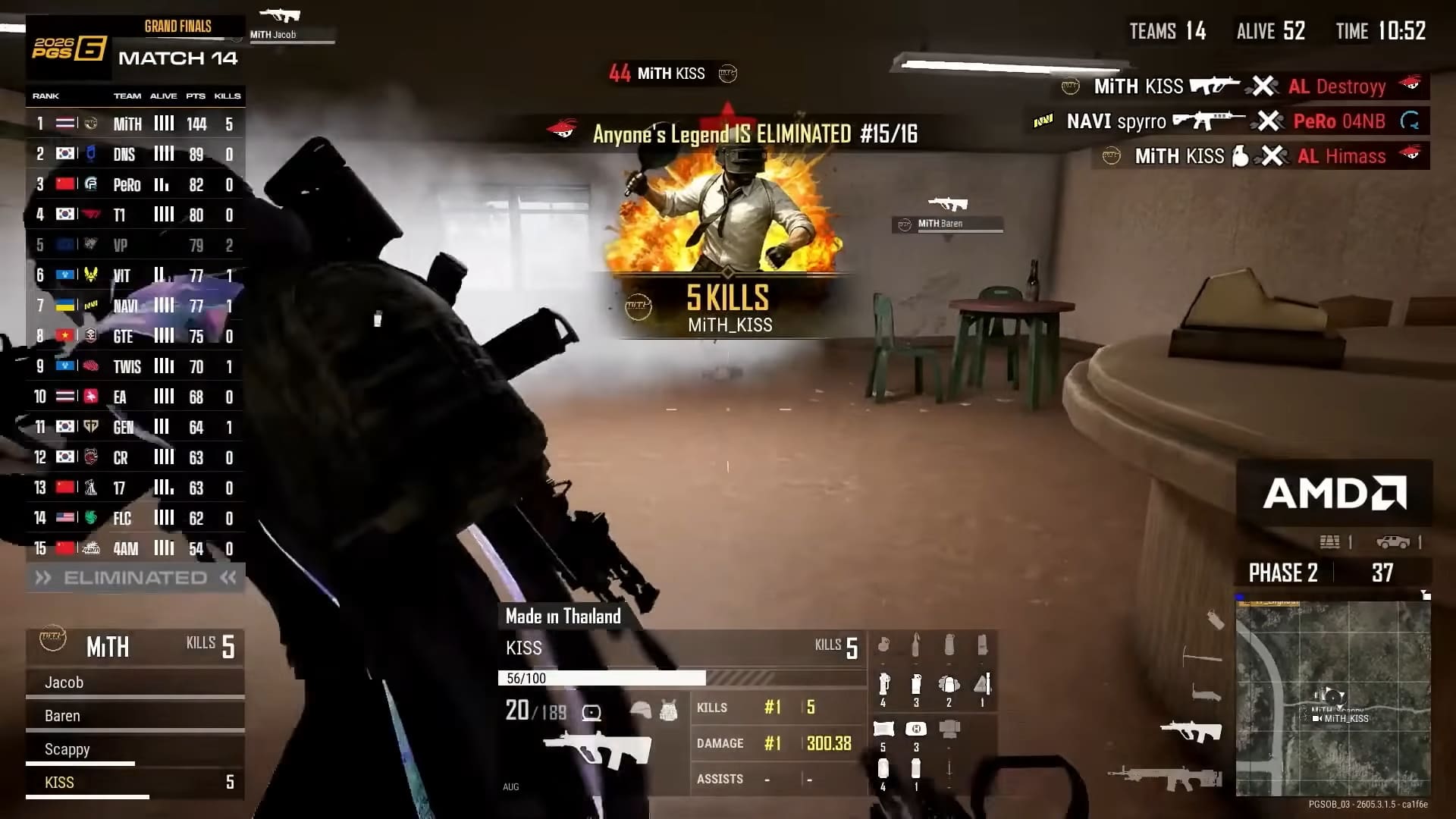
Standing at the center of this data-shattering performance was MiTH's supreme ace and Thailand's best gunner, KISS. While other players were logging kills in the 20s, he proved his ultimate combat prowess by securing 41 kills. His damage output is also on another level. While his teammate Baren recorded 5,064 damage, KISS pumped out an absurd stat line of 6,653 damage. This translates to a personal DPM of 443 across 15 matches. He essentially dominated an international tournament as if it were a regional one. It wouldn't be an exaggeration to call him not just the best gunner in Thailand, but the best gunner in the world, given the form he is maintaining. He also took 1st place overall in Kill Steals with 7 kills. His knockout count tied for 1st place alongside China's Xwudd at 27 knocks.
If you ask whether this was mostly a one-man show, the answer is no. This team heavily prioritizes team play. They shoot together and move together from angles covering each other, strictly maintaining backup distance to defend their positions. Even if a teammate goes down, they instantly make the trade, preventing enemies from easily launching a counterattack, and their defensive capability to hold down key choke points is top-tier. Their assist count—the ultimate indicator of fighting as a unit—also overwhelmingly ranked 1st at 65 assists.
Are they just all aim? Not at all. During standoffs, their creativity in utilizing every single piece of utility they have to pressure and suppress the enemy is outstanding. Their Chicken Dinner in the very first match of Grand Finals Day 1 proves exactly that. Watching them completely obliterate DNS—a team that loves to lay down smokes and take line fights—by combining a C4 with a vehicle they preserved until the very last moment, simply leaves you in awe.
What's even more terrifying is the fact that two of their players will compete as Thailand's representatives in the upcoming PNC 2026. This experience will only forge MiTH into an even stronger force in future international tournaments. It's been a very long time since a team instilled both awe and fear at the same time. Frankly speaking, I don't see a glaring weakness. For the time being, MiTH has become a team that will trap many opponents in an endless cycle of headaches and deliberation.
Conclusion
Looking back at the 9-year history of PUBG Esports, it's true that the era of the APAC region taking center stage hasn't been long. But the wind is changing. That wind is creating new waves, and when those waves soon turn into a tsunami crashing down on us, it makes you wonder if we'll all just be helplessly swept away. Every team, every player needs to prepare. Do you think you can stop a natural disaster?
We might just be standing right in the middle of a new myth being written.
- Jisuboy