

Adapt or die. With PUBG Esports fully transitioning from the first-person (FPP) to the third-person perspective (TPP) this year, the entire meta has experienced a seismic shift. In TPP, vision control and gathering information are more critical than ever. As a result, using destructible terrain to carve out cover on the fly has emerged as a game-changing strategy that few saw coming.
Teams stubbornly clinging to the rigid rotations and heavy-firefight meta of the FPP era are struggling to keep pace. In contrast, rising squads are quickly absorbing these mechanics, weaponizing the terrain to their advantage. Let's break down how this meta shift is actually playing out, using real moments from 2026 PGS 4.
The Era of Excavation
When Patch 41.1 introduced destructible terrain to ranked and esports play on April 7, 2026 (rolling out sequentially on Rondo, Taego, Miramar, and Erangel), players started experimenting immediately. Initially limited to normal matches, it didn't take long for the mechanic to infiltrate competitive play. (Note: Sanhok is excluded from this analysis.)
The Pickaxe suddenly took center stage, though it wasn't an instant hit. The digging animation felt painfully slow, and most importantly, equipping it meant sacrificing the iconic Pan—an item many players rely on as a literal lifesaver. You could stow the pickaxe in your backpack or the trunk of a vehicle, but giving up the Pan made it a tough sell at first.
Everything changed when the feature went live across all esports maps alongside a digging speed buff. The Pickaxe transformed from a gimmick into a must-have utility. In tournament matches, players began trenching into flat ground to manufacture cover out of thin air, sneaking into heavily contested areas ahead of the Blue Zone, and creating ambush angles with zero natural cover. It provides kill points and survival in a single swing. The Pickaxe isn't optional anymore.
It’s not just the Pickaxe, either. Tools previously reserved for purely offensive plays—like Mortars and Frag Grenades—have been repurposed for rotating, defending, and surviving. Pre-shelling your rotation endpoint with Mortars to crater the earth before your team even arrives is now a standard, high-level tactic. It fundamentally flips the value of traditional power positions.
Just look at these moments from the tournament:
Creative rotations (2026 PGS 4 Final Stage D1 M2) https://youtu.be/Z50kcZo6w2Y?t=7367
Insane mortar usage (2026 PGS 4 Final Stage D1 M3) https://youtu.be/Z50kcZo6w2Y?t=9594
That desperate pickaxe moment (2026 PGS 4 Group Stage A+C M3) https://youtu.be/FC5DBkDcR5U?t=36961
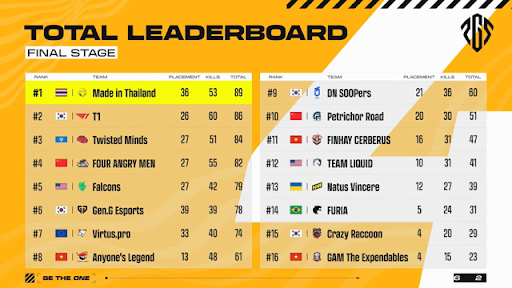
Take Gen.G, for example. After a brutal slump during the 2026 PGS Circuit 1 where they missed the Finals three consecutive times, they fully embraced this new meta. Their mastery of terrain deformation catapulted them to a 6th-place finish in the PGS 4 Finals—a clear sign that something had clicked.
The ceiling on what pros can do with destructible terrain is nowhere near being reached. If anything, the tactics are only getting more creative. Here are a few trends defining the new meta:
Weaponizing the Red Zone
Previously, the Red Zone was just an RNG hazard to survive. Now, it's a landscaping tool. If you track and time the bombing runs, teams trapped on the edge of an open field suddenly get a free, crater-filled rotation path. This strategy has already been heavily tested in the Korean regional circuit (PWS).
C4 Vehicle Bombing for Instant Cover
The classic C4-on-a-car trick is usually for breaching compounds. But what if the goal isn't kills, but construction? Detonating a C4-rigged vehicle in an open field instantly excavates a massive crater for your squad to play from. No C4? Drive a low-HP vehicle to your spot, blow it up yourself, and use the resulting blast radius as a makeshift trench. The battlefield is no longer something you find; it’s something you build.
Pit Trapping
Pro teams instinctively clear buildings before entering—checking every corner for threats. But what if the defenders aren't inside the compound? Digging defensive trenches around the perimeter and ambushing the attackers from outside flips the engagement on its head.
Here's a perfect example of GK’s pickaxe trap: https://youtube.com/shorts/tKVH-d-snLQ
Countering these terrain manipulation tactics is now mandatory at the pro level. While Mortars are the hardest counter to trench-diggers, not every team runs them effectively. This puts a heavy premium on utility fundamentals: perfectly cooked Frag Grenades, precise Molotovs, and playing the Blue Zone timing. Reading the geometry of a man-made pit and anticipating the psychology of the defenders inside it is crucial.
Surviving the New Era
PUBG has always been more than just a shooter; it’s a pure survival game that demands everything you've got. Raw gunplay isn't enough anymore. You have to read the chaos, adapt to RNG, and increasingly—force your own variables. To a casual viewer, a pro swinging a Pickaxe at the dirt might look like a meme. To the players, that single swing is the difference between taking the Chicken Dinner and a devastating early exit.
Survival at all costs—that’s the core of PUBG. Pros aren't waiting around for a lucky circle shift or a good position anymore. They’re building their own. This new era doesn't just ask how well you shoot; it asks how long you can last.
Next Episode: PGS 6 Winner Predictions
- Jisooboy